
Shedding Spiritual Weight: Releasing Negative Self-Talk, Shame, and Beliefs That Keep You Heavy

Not all weight is physical.
Many women are carrying heaviness that cannot be measured on a scale. It may come from shame, negative self-talk, old labels, hurtful words, regret, comparison, or beliefs they never consciously chose but somehow learned to carry.
This kind of weight can affect how you see yourself, how you care for your body, how you receive love, how you rest, and how you move through the world. That is why whole-person healing matters. Human beings are mind, body, soul, and spirit—damage or trauma in one area can affect the others, but the same is true for healing.
When you begin to shed weight in your spirit, your mind and body can begin to respond too.
What Is Spiritual Weight?
Spiritual weight is the inner heaviness that builds when you keep carrying what God never asked you to keep. This often manifests as shame, self-condemnation, perfectionism, people-pleasing, comparison, regret, or the belief that you are only valuable when you perform, produce, or look a certain way.
Spiritual weight can come from hurtful words you still carry, old labels that no longer belong to you, lies you have mistaken for identity, pressure to prove yourself, and negative self-talk that has become familiar.
It can also become a secret saboteur. You may be working hard to change your body, improve your habits, or pursue a healthier life, but still feel heavy inside because your spirit is carrying something unresolved.
Your body may be changing, but your inner narrative may still be rooted in shame.
The Brain Follows What You Practice Believing
Your brain is always learning. The thoughts you repeat, the beliefs you rehearse, and the words you speak over yourself can strengthen certain mental pathways over time.
If you wake up every morning agreeing with thoughts like, “I’m failing,” “I’m ugly,” “I’m too broken,” “I’ll never change,” or “I should be farther along by now,” those thoughts do not stay isolated in your mind. They can influence your stress response, confidence, choices, relationships, and the way you care for your body.
This does not mean every struggle in your body is caused by negative thinking—that would be overly simplistic—but your thoughts and beliefs do matter.
When your inner world is filled with accusation, fear, and shame, your body may begin to live in a state of stress too. That is why healing cannot only focus on the outside: the mind and spirit need truth, tenderness, and renewal too.
Why Weight Loss Alone Does Not Always Heal Self-Worth
Many women have experienced this firsthand. They put in immense effort, lose weight, reach a goal, change a clothing size, or improve a health marker—and still do not feel more peaceful, confident, or whole.
That can feel confusing. You may think, “I worked so hard. Why don’t I feel better about myself?”
If your body changes but your spirit is still carrying shame, the heaviness remains in another form.
Your value cannot be healed by appearance, and your worth cannot be repaired by performance. You do not become more lovable by becoming smaller, more productive, more impressive, or more approved.
The deeper work is learning how to stop agreeing with the lies that keep your spirit heavy.
Negative Self-Talk vs. How God Speaks About You
Many women speak to themselves in ways they would never speak to someone else. You may say things like:
- “I’m disgusting.”
- “I have no discipline.”
- “I always mess things up.”
- “I should be better than this.”
- “I’ll feel good about myself once I fix this.”
But pause for a moment and ask: Would I speak this way to a child? Would I speak this way to someone God loves?
You are God’s child, and Scripture is very clear on God’s perspective regarding His children.
Psalm 139:14 says, “I praise you because I am fearfully and wonderfully made.”
Psalm 139:17 says, “How precious to me are your thoughts, God! How vast is the sum of them!”
1 John 3:1 says: “See how great a love the Father has given us, that we would be called children of God; and in fact we are.”
Remember, the voice of shame is not the voice of God.
God does not form His daughters through humiliation. He does not define you by your hardest season, your body size, your productivity, or your past pain. He always leads with truth, conviction, love, and restoration.
If your self-talk is harsh, condemning, or cruel, it is worth asking whether you have been listening to a lying voice for too long.
Healing Begins When You Align With God’s Truth
Healing begins when you stop letting shame define your identity and begin aligning with what God says about you.
This does not mean you ignore areas where you want to grow, or pretend everything is fine—it means you stop trying to hate yourself into healing.
You can care for your body without despising it. You can pursue growth without punishing yourself. You can acknowledge pain without letting it become your name. And you can desire change without making your current self unworthy of love.
Spiritual alignment with how God sees you sets the foundation for everything else in your mind and body. And when you abide in God’s love, your identity becomes less dependent on appearance, performance, approval, or past pain. You begin to live from a deeper place of steadiness knowing that:
- You are not your shame.
- You are not your past.
- You are not your performance.
- You are not your appearance.
- You are not the lie someone spoke over you.
You are God’s creation, His beloved child, and you are worthy of care.
A Scripture-Based Spirit Reset for Shedding Spiritual Weight
Shedding spiritual weight doesn’t usually happen in one dramatic moment. It is often a daily practice of noticing what you have been carrying, releasing what does not belong, and replacing lies with truth.
1. Notice the lie
Start by paying attention to the thought that keeps repeating.
Ask yourself:
- What have I been saying about myself?
- Where did this belief come from?
- Does this thought bring peace, or does it bring shame?
- Does this sound like God’s voice?
You cannot release what you have not named.
2. Replace the lie with truth
Once you identify the lie, replace it with truth rooted in who God says you are.
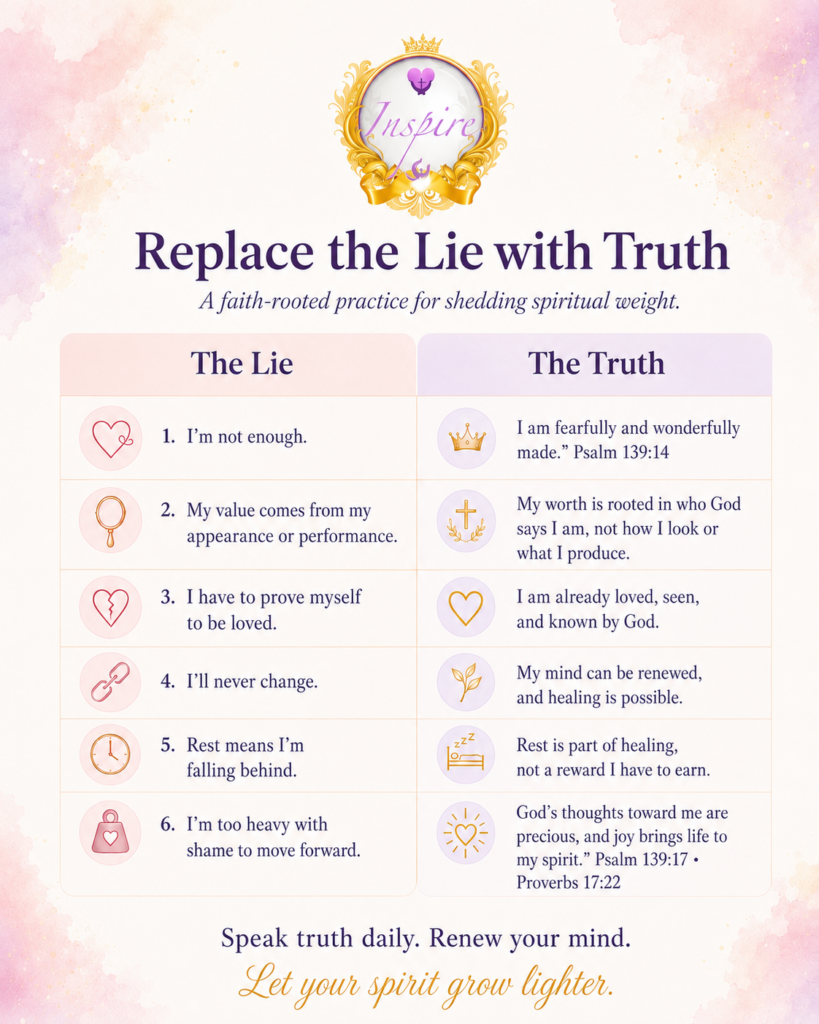
Let those truths become louder than the lies.
3. Speak to yourself as God’s child
Before you repeat a harsh thought, ask:
- Would I say this to a child?
- Would I say this to someone I love?
- Would I say this to someone God created?
If the answer is no, pause.
You are not being “honest” with yourself when you speak with cruelty. You are rehearsing shame. Truth may convict, correct, and guide, but it does not destroy your dignity.
- Instead of: “I’m disgusting.” Try: “I am struggling, but I am still worthy of care.”
- Instead of: “I always fail.” Try: “I am learning a new way forward.”
- Instead of: “I should be better than this.” Try: “I can grow without shaming myself.”
4. Renew your mind daily
Renewal happens through repetition.
Each day, you have the opportunity to practice a new agreement with truth. This may happen through prayer, Scripture, journaling, worship, stillness, breath, community, counseling, coaching, or simply pausing long enough to interrupt the old pattern. You might pray:
“Lord, help me recognize the thoughts I have been agreeing with that do not come from You. Help me release what is rooted in shame and receive what is rooted in truth.”
Healing often begins one thought at a time.
5. Lean into joy
Joy is not denial. Joy is spiritual nourishment.
Proverbs 17:22 says, “A joyful heart is good medicine.”
Proverbs 14:30 says, “A heart at peace gives life to the body.”
For many women, joy feels difficult to receive because they have spent so long surviving, proving, grieving, or striving. But joy is not something you have to earn after everything is fixed. Joy can be part of the healing.
Ask yourself:
- What brings my spirit peace?
- Where have I stopped allowing joy?
- What would it look like to receive joy without guilt?
6. Look in the mirror with truth
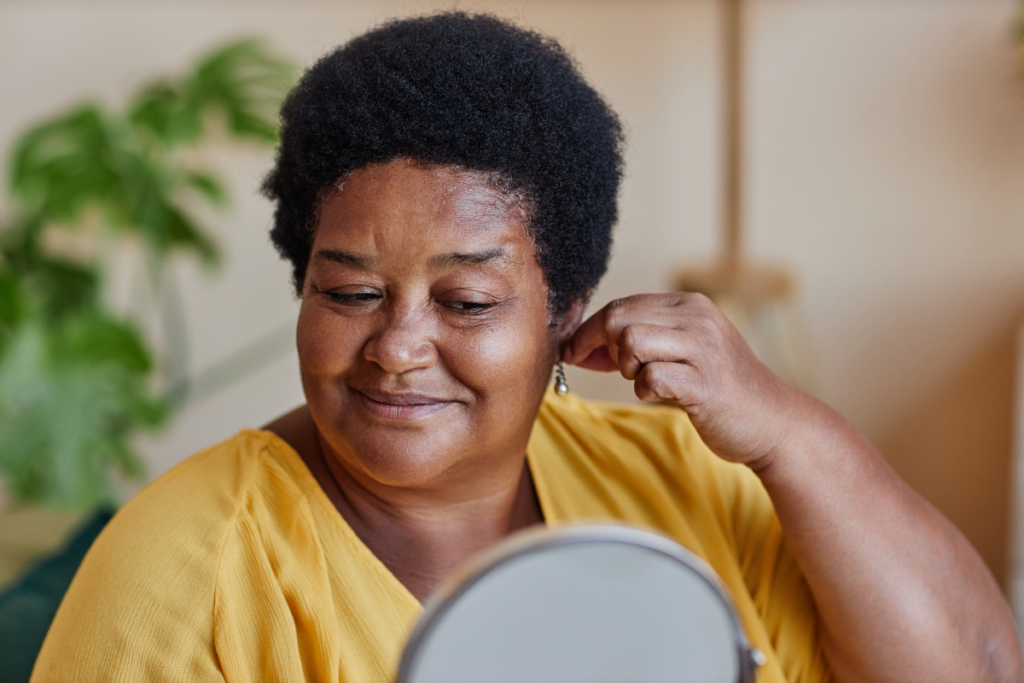
For many women, the mirror has become a place of inspection, disappointment, or criticism. But it can become a place of truth.
The next time you look in the mirror, pause before criticizing yourself. Pray:
“God, help me see what You see.”
Then speak truth:
- I am not my shame.
- I am not my past.
- I am not my performance.
- I am God’s creation.
- I can care for this body with love.
This is not about pretending you do not have goals or feelings. It is about refusing to let the mirror become the final authority over your identity.
A Final Word for the Woman Carrying More Than She Can Name
If you have been carrying spiritual weight for a long time, I want you to know this: you are not weak, and you are not beyond healing. You may simply be tired of holding what was never yours to keep.
You do not have to keep agreeing with lies or carrying shame and negative words that were never yours to keep.
As you begin shedding spiritual weight, you may find that your thoughts begin to soften, your body begins to exhale, and your healing begins to deepen. That is the beauty of whole-person healing: when the spirit finds truth, the rest of you will follow.
About Dr. Crystal Hines-Mays
Dr. Crystal Hines-Mays is a board-certified family medicine physician, Fellow of the American Academy of Family Physicians, and certified life coach. Through Freedom to I.N.S.P.I.R.E, LLC, she helps individuals rebuild health, identity, and self-worth through a whole-person approach: body, mind, soul, and spirit.
To continue this healing journey:
- Explore the INSPIRE Personal Journey for deeper support in healing your identity, rebuilding self-worth, and aligning your life with truth.
- Join Freedom Friday for continued encouragement and faith-rooted reflection in the middle of real life.
- Invite Dr. Crystal to speak for women’s groups, retreats, wellness events, and leadership spaces.